
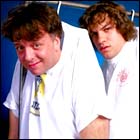
Formed in 1984 in New Hope, Pennsylvania, Ween established itself as one of alternative rock's most creatively unpredictable and cultishly adored acts. The brainchild of childhood friends Aaron "Gene Ween" Freeman and Mickey "Dean Ween" Melchiondo, the band built a legendary career on a foundation of irreverent humor, stylistic schizophrenia, and a surprisingly profound musicality that could shift from absurdist noise to poignant melody in an instant. Their journey from lo-fi cassette traders to major-label eccentrics and beloved live institution is a testament to their unique vision.
The duo's early work was defined by a prolific, home-recorded output on cassette before transitioning to their first official lo-fi albums: "GodWeenSatan: The Oneness" (1990), "The Pod" (1991), and "Pure Guava" (1992). It was the latter that brought them unexpected mainstream attention, as the single "Push th' Little Daisies" became a surprise chart hit in Australia and the United States, landing them an appearance on Beavis and Butt-Head. This success led to a deal with Elektra Records, where Ween began to expand their sonic palette with more professional studio resources while retaining their eccentric core.
Their major-label era produced a celebrated and wildly diverse run of albums. "Chocolate and Cheese" (1994) saw them fleshing out their sound with full-band arrangements, while "12 Golden Country Greats" (1996) was a loving, straight-faced excursion into classic Nashville, recorded with legendary session musicians. The ambitious, nautical-themed "The Mollusk" (1997) is often cited as a masterpiece of psychedelic rock and later served as a key inspiration for the animated series SpongeBob SquarePants. They closed their Elektra chapter with the more polished, pop-influenced "White Pepper" (2000).
Returning to independent labels, Ween released "Quebec" (2003) and "La Cucaracha" (2007), continuing to tour relentlessly with their accomplished live band featuring Claude Coleman Jr., Dave Dreiwitz, and Glenn McClelland. A pivotal collaborator throughout their history was Andrew Weiss, who served as bassist and producer on several key albums. In 2012, after 28 years, Freeman announced his departure from Ween to address substance abuse issues, seemingly ending the band. However, in a move celebrated by their devoted fanbase, the core duo reconciled and reformed in late 2015, embarking on extensive and successful tours. While initially focused on live performances, the band entered an indefinite hiatus in 2024, with Melchiondo citing his mental health as the reason. Despite their fluctuating status, Ween's legacy as fearless musical satirists and genuinely gifted songwriters remains firmly intact within the alternative canon.